
Welcome to
Peaceful Reflections
Exploring the rhythms of life, one reflection at a time.
Peaceful Reflections is a collection of personal narratives inspired by the maternal journey, nature, movement, and the everyday moments that invite us to pause and pay attention. Rather than offering answers, each reflection follows a thread of curiosity, exploring the universal patterns that shape our lives and the evolving seasons of womanhood. My hope is that somewhere along the journey, you'll discover reflections of your own.
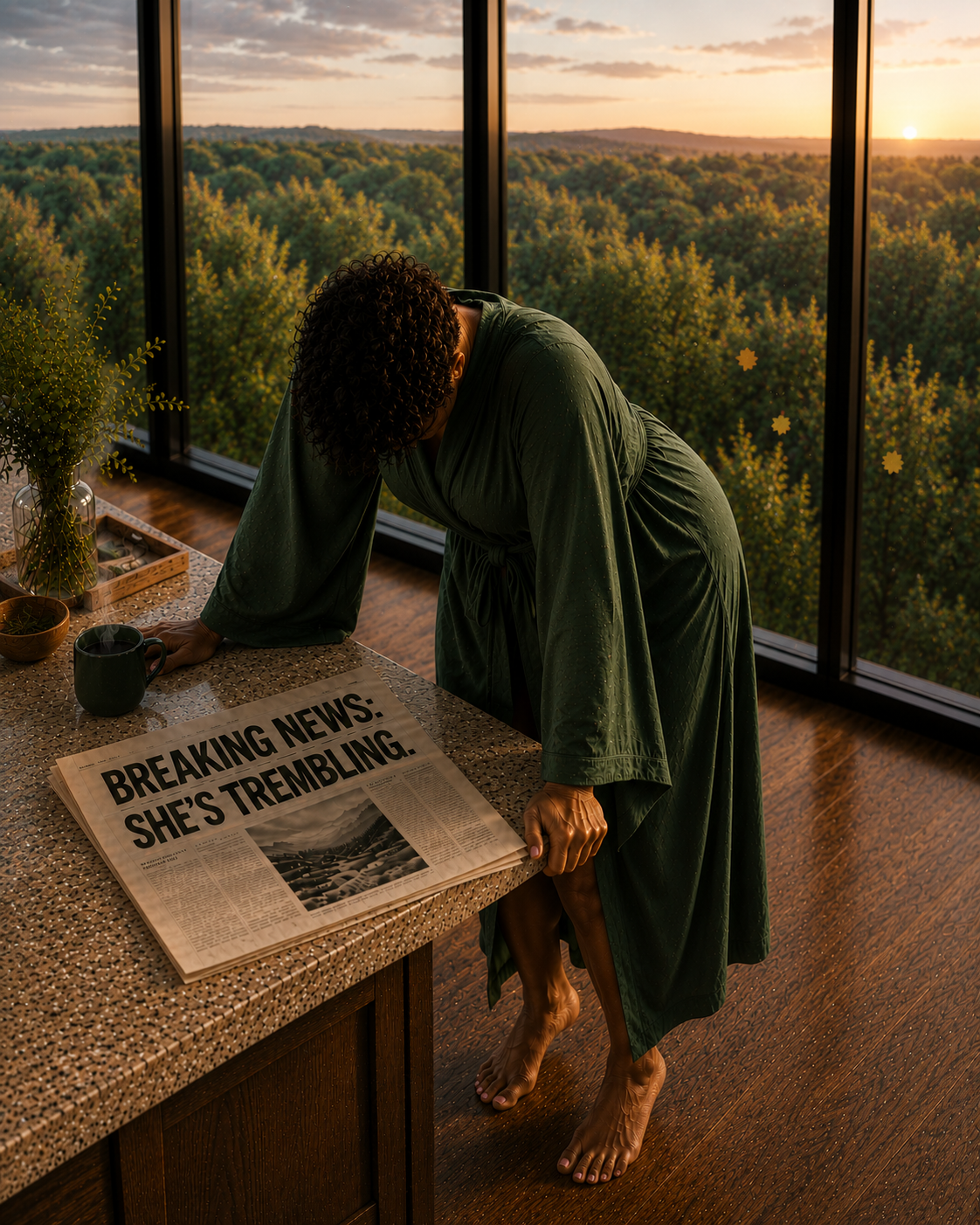
The Trembling of Transition
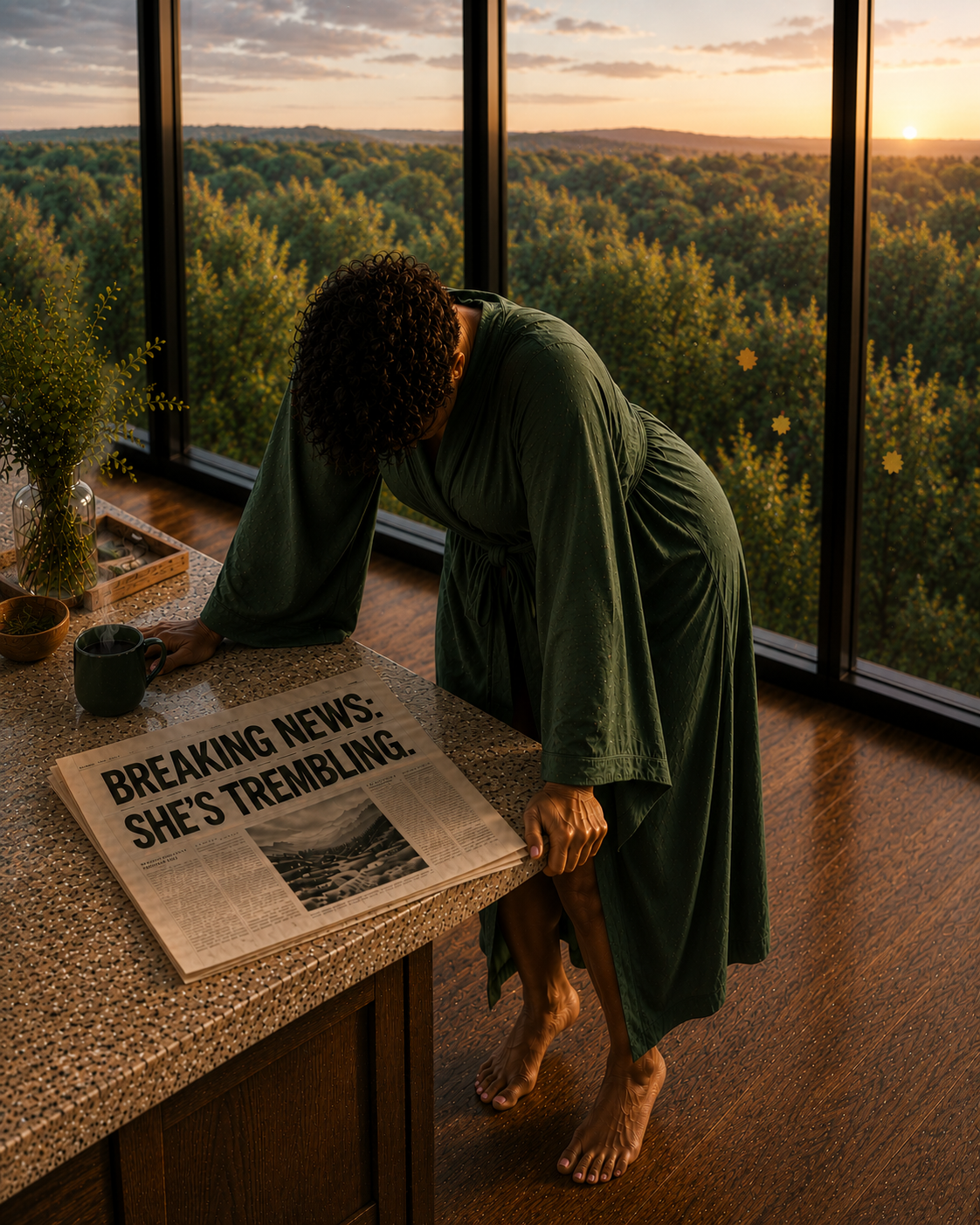
Something is happening,
and the body knows it before anyone announces that she has entered a new phase.
The Trembling of Transition
When you watch a woman transitioning in labor, many tremble. They shake.
Even as I write that, those who work in birth may already have a visual of the phase we commonly call transition.
There is a birth video that has been shown in childbirth education classes for years. In one scene, a laboring mother is turned onto her side in the bed, gripping the rail. Her body is trembling as she braces herself through the intensity of what she is experiencing. Nothing is announced.
The narrator doesn't point it out or explain what we are seeing. The video simply continues. Yet every time I reference that moment after showing the video, I barely have to finish my sentence before heads begin nodding around the room. They saw it. Although no one talked about it or gave it a name, they recognized that something had changed.
There is often a hint of concern behind those nods, too. I can see the anticipation as they wait for me to explain what they just witnessed. Why was she shaking like that? Is that normal? Should I be afraid if that happens to me?
I find that moment fascinating because the body communicated something significant enough for people with no clinical birth experience to recognize that a transition was occurring, even though no one had given them language for it. Interestingly, transition itself is not formally identified as a separate stage of labor.
The first stage is generally divided into latent and active phases, while "transition" is commonly used to describe that intense period toward the end of cervical dilation. Whether formally named or not, those of us who have stood beside laboring women witness it.
The body may shake as the intensity changes. What had been manageable moments earlier can suddenly feel destabilizing, and a woman who has been coping beautifully may begin saying that she can't do it anymore.
For someone hoping to labor without medical pain management, this can be the point when she begins questioning that decision. Those standing beside her can become frightened too, particularly when they don't recognize what they are seeing.
Something is happening, and the body knows it before anyone announces that she has entered a new phase.
In birth work, we sometimes describe this trembling as the body "shaking the apple tree." Giving it that imagery can make the experience feel less alarming to the birthing person and the people supporting her. Rather than immediately interpreting the shaking as a sign that something is wrong, there is another possibility to consider: her body may be responding to and moving through an incredibly demanding process.
At times, we even mimic that shaking manually with assistance, introducing gentle shaking or jiggling to encourage the body to release some of the tension that naturally accompanies intensity. The explanation matters because it changes the way everyone in the room interprets what they see. A body that appears to be losing control can instead be understood as a body actively moving through transition.
But there is another transition I have witnessed countless times that we don't talk about in quite the same way. The baby has been born. The work of opening has ended, and the mother's body begins its return. She may tremble and shake then, too.
Our response to that shaking is completely different. Warm blankets come out almost instinctively as we cover her, offer reassurance and remind her, It's okay. This is normal. Just breathe. There isn't usually the same fear in the room. The shaking may be surprising to the woman experiencing it, but to those of us who recognize it, it makes sense.
Her body has just done something enormous. There is an explanation for her trembling.
I've been thinking about the difference between those two moments. One transition happens as the body is opening toward birth. The other follows the birth, as the body begins closing and moving toward recovery.
Both can involve trembling, but the first can feel frightening because we don't yet know what waits on the other side. The second feels justified because we can point to what just happened.
She just gave birth.
Perhaps the transitions carrying us toward something we cannot yet see are inherently more destabilizing than those following an ending we can explain. We tend to give ourselves more grace when we can look backward and justify why we are tired, unsettled or unsure. Offering ourselves that same understanding can be much harder when the trembling comes before we have language for what is being born.
It makes me wonder whether transitions in life follow similar patterns.
Do trees experience their own version of trembling as they push out new leaves in spring? Is there some tiny vibration beneath the ground as it warms enough to support new growth? What happens within a tree as summer ends and it begins extracting what it can from leaves that will soon be released? Is there a vibration as those leaves prepare to fall, or as the ground hardens in preparation for the cold and the grass begins to disappear?
I don't know whether nature literally trembles through those changes. I do know that nature rarely moves from one state into another without a transition between them.
Which brings me to September.
There is another reason this reflection feels particularly fitting today. Sixteen years ago, to the day, I experienced both sides of this trembling myself during the labor and birth of my son. I experienced the shaking that came with opening toward his birth, followed by the trembling that came afterward as my body began closing and recovering from what it had just done.
Yesterday was September 1, the day monthly announcements, newsletters and reflections tend to arrive. Mine didn't. Instead, it is arriving today, on the anniversary of my own experience with the trembling of transition. Somehow, that feels more appropriate.
Sixteen years later, I find myself in another transition. My son is entering another season of his own development, my experience of motherhood continues to change alongside him, and the work that grew from so much of what I learned not just through supporting others, but through my own pregnancy, birth and mothering experience is transitioning too.
September and the Space Between Seasons
September is a transitional month. We enter it in summer, surrounded by warmth, activity, vibrant colors and the fullness that has been building since spring. Before the month ends, we cross into autumn. Temperatures begin fluctuating, daylight gradually retreats, and the colors around us transition before eventually becoming more muted and disappearing.
Nothing has gone wrong. The season is changing.
Over this past month, I have noticed some trembling of my own. Not necessarily physical trembling, but the internal destabilization that happens when something you've understood one way begins asking to be understood differently.
I have felt it personally, but I have also felt it in my work and in Peaceful Motives.
What makes this particular transition interesting is that the question underneath it isn't new. In many ways, it has followed me throughout my career:
What have these experiences taught us that we can carry beyond motherhood?
Long before I had language such as the Maternal Lens to describe it, I was noticing connections. My experiences across nursing, childbirth education, birth work, movement and motherhood kept showing me patterns that didn't seem confined to pregnancy or parenting. The reproductive journey was teaching me something much broader about people and the ways we prepare, adapt, resist, surrender, communicate, develop, recover and move through change.
What feels different now isn't the question. It is my willingness to follow it further.
That distinction matters because Peaceful Motives isn't suddenly moving away from maternal work in search of something else. Pregnancy, birth, postpartum, movement and motherhood are where much of this understanding was formed. What is transitioning now is the container I have built around that knowledge and my understanding of how expansive its application may actually be.
The Woman Within Motherhood
A woman can deeply love being a mother and still crave conversations that have absolutely nothing to do with taking care of her child. She may want space to explore an idea she has been carrying, examine something happening in a relationship, think differently about her work, understand a change within herself, or simply engage the parts of her mind that are curious about something beyond the immediate responsibilities of mothering.
I no longer see that as a woman needing to "discover a new version of herself." Motherhood changes us, but change and loss are not synonymous. The woman is still there, continuing through her own development while simultaneously witnessing and supporting the development of another human being.
I understand that differently now that I am raising a teenager than I might have when I was immersed in the daily physical care of a young child. My experience of motherhood has changed, giving me room to look back at pregnancy, birth, postpartum and child development through another lens.
Pregnancy gives us an intimate experience of expansion and adaptation. Labor demonstrates how intensity can rise and fall and how something that worked beautifully at one point may no longer be appropriate as conditions change. Birth brings us to a threshold where what existed before cannot remain exactly as it was. Postpartum makes something particularly visible that our culture often overlooks: an event can be finished while the person who experienced it is still integrating what happened.
Years of supporting parents as they watch their children develop adds another dimension. Development is rarely a smooth climb toward maturity. Periods of rapid growth we call “growth spurts” are followed by plateaus. Those seasons of growth don’t just birth new abilities known as milestones, they often temporarily or permanently disrupt old rhythms. We generally understand these fluctuations when watching children because we recognize development as a process, not an event. A dear friend shared that reminder with me years ago as I picked my son’s poop up off the very expensive rug in our friends’ home during his potty-training season.
The same patterns become visible in our professional lives. Teams go through periods when old ways of working are no longer sufficient but new ones have not yet stabilized. Leaders can recognize that something within an organization is shifting long before they can articulate exactly what it will become. A career can still look intact from the outside while the person living inside of it already knows that something is changing.
Adults don't always receive that same allowance.
We are often expected to identify what is wrong, decide what needs to change and proceed toward the solution. Actual human development is rarely that orderly. A career shift, relationship change, transition into motherhood, transition out of intensive mothering, a changing body, a creative awakening or an evolving sense of purpose may include a period when we simply don't know what comes next.
My maternal experiences have given me a framework for understanding those periods differently.
That is becoming the heart of what I mean when I talk about looking at life through the Maternal Lens.
Taking the Maternal Lens Beyond Motherhood
Peaceful Motives began within maternal and reproductive spaces, and those roots remain important. What is expanding is my understanding of what can grow from them.
I am increasingly interested in the knowledge women carry from their maternal experiences into the rest of their lives, including their relationships, work, creativity, leadership and understanding of themselves. There is also another group I find myself wanting to invite further into this conversation: the professionals who spend their careers alongside women and families.
Birth workers, nurses, childbirth educators, therapists, movement professionals and others witness human transition from particularly intimate vantage points. Over time, we accumulate observations about adaptation, communication, vulnerability, resistance, autonomy, support and change. Some of that knowledge may have relevance far beyond the settings where we originally learned it.
I want to explore what happens when we carry it outward.
There are principles within maternal health, reproductive transitions and human development that may have something meaningful to contribute to how we understand relationships, workplaces, leadership, caregiving and our own periods of becoming. I don't yet know every place that exploration will lead, and I am becoming increasingly comfortable with not forcing myself to decide.
Perhaps that is part of what this particular transition is teaching me.
Recognizing the Trembling
There is a tendency to treat transition as an inconvenient hallway between two important rooms. We want to identify what we are leaving, determine where we are going and get there as efficiently as possible.
Nature seems considerably less concerned with efficiency. September does not wake up one morning and become fall. Summer gradually loosens its hold while autumn begins appearing within it. For a while, both are true.
An identity can still fit while another part of us is expanding beyond it. Work that has been meaningful doesn't have to become meaningless simply because additional possibilities are beginning to reveal themselves. Recognizing that change is underway also doesn't obligate us to immediately name its destination.
I keep thinking back to that mother in the birth video.
She is gripping the rail and trembling. Nobody narrates the transition for us, yet the people sitting in my childbirth classes recognize that something is happening before I ever give them the explanation.
Maybe there is something in that for us.
An obvious ending gives us something concrete to point toward when we feel unsettled, making our response seem justified. The transitions that begin while everything around us appears relatively unchanged can be harder to understand. Nothing dramatic may have happened at all. The discomfort may instead be coming from the realization that something is already happening within us.
As September carries us from summer into fall, I am less interested in rushing to define what Peaceful Motives, my work, or even I myself am becoming. I am more interested in paying attention to the movement that is already underway.
After spending years watching women move through labor, perhaps I should know this by now:
Sometimes the trembling comes before the birth.

Preparing to Descend

BREAKING NEWS:
“She’s preparing to descend.”
It Started with a Question
Entering August, I found myself wondering if there was anything significant about this month. Not just because it's another page on the calendar, but because I've come to believe that everything is connected. The rhythms we experience in nature don't seem separate from the rhythms we experience within ourselves, so whenever something catches my attention, I become curious about the pattern behind it.
As usual, my mind wandered first to the maternal journey.
That's often where my reflections begin. Not because I believe everything is about pregnancy or birth, but because the maternal journey has become the clearest lens through which I understand life. Pregnancy, labor, birth, postpartum, motherhood, even perimenopause...they're all seasons that live beneath the much larger umbrella of womanhood. When I begin there, I usually find myself seeing connections that stretch far beyond maternity.
Following that thought a little further, another question emerged.
If July represents the peak of summer, and if I were to plot the year on a bell curve or even a labor contraction, what is August?
At first the answer seemed simple.
August is the turning point.
The Season Before the Season
That's when I realized something I had never consciously noticed before.
August is the last full month of summer.
September is when we begin experiencing the transition into fall, but August is where the preparation quietly begins. The calendar still says summer. The trees haven't suddenly changed overnight. Most of what we see looks exactly the same. Yet something is already shifting. It's subtle enough that we could miss it entirely if we weren't paying attention.
Preparation begins before the season changes.
That realization stayed with me longer than I expected. Nature doesn't seem to wait until a new season arrives before preparing for it. The preparation happens while we're still calling it by the old name.
One Word Changed Everything
Another thought appeared.
If August is preparing for what's next, the season we call Autumn, more commonly known as Fall, maybe it's about preparing to descend.
That word caught me off guard.
Descend.
I wasn't looking for it, and honestly, I wasn't immediately comfortable with it. Descending can sound heavy. It can make us think about falling, losing momentum, or giving something up. Rather than replacing the word with one that felt easier, I decided to stay with it.
Why does descending feel unsettling?
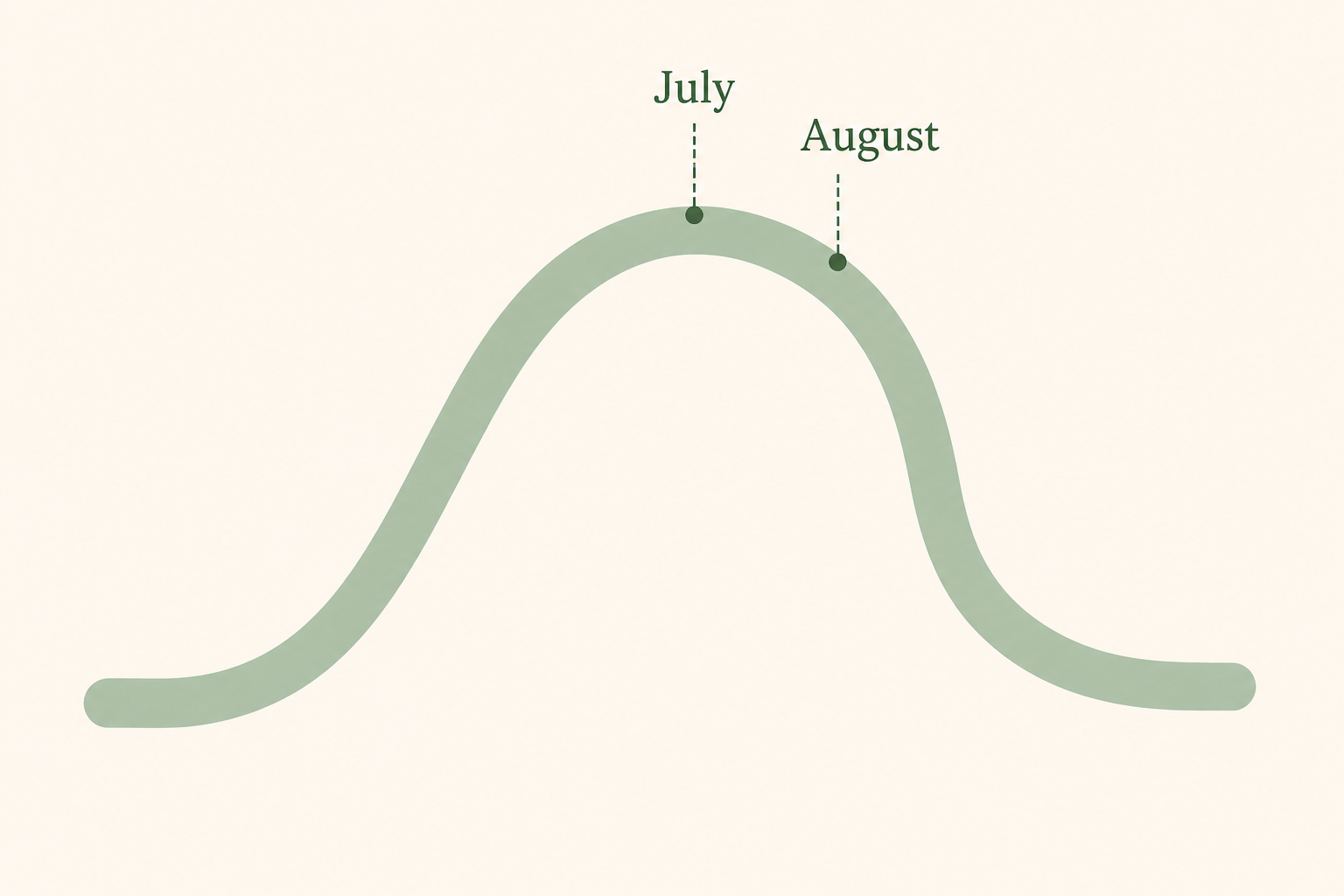
If July is the peak of the year, holds the peak of summer, and if plotted on a bell curve would be designated as the peak of a contraction, what is August?
August is the turning point.
The Hill
Almost immediately another image came into my mind.
Imagine driving toward the top of a hill. You've spent time climbing and then, almost without noticing, gravity begins taking over. It's fascinating how differently people respond to that same moment. Some instinctively press the brakes. Others tighten their grip on the steering wheel. Then there are those who almost seem excited by the feeling, leaning into the descent as though they've been waiting for it all along.
Each encounters the same hill, the same gravity.
Yet somehow we each develop a different relationship with the experience.
What makes one woman brace while another seems able to move with the flow? Is it personality? Is it experience? Is it something we've learned? Does it depend on how much we've been carrying before we ever reached the top of the hill?
I didn't have an answer.
Only more questions.
The Brakes
As those questions continued unfolding, I realized I wasn't actually trying to figure out whether we should keep our foot on the brake or throw our hands into the air.
Maybe those aren't the only two choices.
When we're driving downhill, we don't usually slam on the brakes the entire way, and we don't always take our feet completely off them either. We adjust, ease up, and press down when it's needed, then release again. There's a relationship between trust and attentiveness that allows us to keep moving without feeling out of control.
For a spilt second, I relaxed thinking, that’s the revelation of the month.
Preparation isn't about stopping the descent.
It's about learning how we'd like to experience it.
At least, that's what I thought.
Then the Reflection Deepened
Learning how to ease off the brakes, learning how to descend without feeling out of control, seemed like enough to sit with for one month.
However, like most moments of reflection, one leads to another, which leads to another.
What if I've already practiced bracing long enough?
I know how to use the brakes. I don't have to imagine what it feels like to grip. I know that feeling well. In many ways my body has been faithfully mirroring what I've been doing energetically. Tight places that don't want to let go. Catching myself clenching without realizing it. Having to intentionally remember to soften my jaw, release my shoulders, relax my core and pelvic floor, take a full breath.
But bracing isn’t the state of being I live in. Is it?
When did I/do I begin pressing on the brake?
Ripe & Ready
Leading up to the peak of summer, nature doesn't brace fruit into maturity or stiffen to prepare for harvest season.
Pregnancy doesn't prepare for birth by becoming harder.
The body softens, hips spread, the cervix ripens.
Tissues become more receptive.
Everything necessary for birth happens through readiness rather than force.
Readiness to open, to receive, to respond.
So, what can we do during this season to become more ripe ? How do we recognize when we are ready?
Following the Urge
Somewhere between thinking about ripening and thinking about the descent, I realized I'd skipped over something. I'd become so focused on preparing for the fall that I'd quietly started behaving as though summer was already over. Yet every time I looked outside, nature kept interrupting me. Nothing is winding down. Gardens are still producing. Fruit is still ripening. Everything that opened in spring is continuing the work of becoming, which made me wonder why I was so eager to leave the season I was still standing in.
Looking back, I realized I haven't actually struggled with the request to open. I’ve had no issues with the build up of the waves themselves. I've always loved the feeling, the opening, the stretching, the softening. Surrendering to that process has never felt difficult because the wave wasn't asking anything of me except to stay present and allow it to do what it came to do. Somewhere along the way, that became a skill I trusted.
But everything changes when the urge arrives.
Up until a point, the wave doesn’t ask me to activate. Throughout the majority of the the experience we call labor, every wave of energy asks me to soften instead of tighten, to open instead of resist.
Somewhere the conversation changes. The same wave that had been asking for surrender now asks me to participate. It calls different parts of me to engage. It invites me to add my effort to something that's already happening, and that's the place where I've historically become uncomfortable.
The more I sat with that, the more I realized the discomfort isn't really about pushing. It's about what I've made pushing mean. Somewhere I've come to believe that if I follow the urge completely, it will cost me my peace. Yet resisting the urge hasn't protected my peace either. It has simply kept the pressure building inside until it found another way to get my attention.
That thought led me somewhere I hadn't expected.
Why have I been acting as though all of the support disappears once it's time to push?
During the opening, I instinctively reach for every comfort measure available. I dim the lights, turn on the music, sway, breathe, get into the water, lean on my support people, create an environment that helps me stay present. Then the urge arrives and somehow I forget that birth doesn't suddenly stop being supported. Where's my squat bar? My sling? The mineral oil? My coach? My people? Can I push standing, squatting, kneeling, in the water? Can I still step into the sun between contractions and let it warm me? Cool off. Drink some water. Laugh. Rest. Let the next wave build instead of rushing ahead of it. Why was I acting as though pushing meant abandoning everything that helped me trust the journey in the first place?
Maybe that's been my mistake.
I wonder how many of us have been treating surrender and pushing like they're two different experiences when they're really part of the same one. The opening requires surrender. The urge requires surrender too, just in a different form. Instead of surrendering by softening, we’re being asked to surrender by trusting the internal reflex. The requested effort isn't a separation from the flow. It's our invitation to join it.
As I sat there, I couldn't ignore the parallel. This reflection had done the same thing to me. I loved exploring the idea. I loved watching it unfold, asking questions, following the waves wherever they led. Then came the moment when it was time to bring something forth, and suddenly all I wanted to do was stop. I wanted to skip over the very part that gives birth to what's been growing.
Maybe that's what August has been showing us.
She's (Mother Earth) preparing for the fall by fully embracing summer. Not by pretending the work is finished, but by allowing summer to complete what she began in the spring.
Perhaps that's what those of us who are sensitive to the energic shifts are being invited to do too. Stay with the season we’re in. Trust “the urge to push” when it comes. Reach for the support that's already around us. Then participate in the release instead of fearing it, knowing that restoration isn't something we have to chase. It arrives after the labor and birth, after the pushing of this season has been allowed to become complete.

Release the Poop!
It All Begins Here
This may be a sensitive topic for some people.
A few years ago, I was invited to speak at a virtual summit. When the organizer asked for the title of my presentation, I told her it was called, ‘Release the Poop!’. There was a pause that suggested she was questioning whether I was serious.
The funny thing is, I wasn't trying to be funny.
I had been sitting with an analogy for a while but, before committing to it publicly, I’d decided to look up the word poop to make sure I wasn't completely off my rocker. (A lesson I learned from my father and mother, look up definitions.)To my surprise, one of the historical meanings stated it referred to information, news, or the inside scoop. There are old expressions such as "What's the poop?" and "Give me the straight poop." Some sources even connect the phrase to military slang, related to the poop deck where the captain observed the crew and shared information among sailors. The moment I found that definition, the analogy clicked!
We consume information all day long. We consume conversations, books, experiences, podcasts, social media posts, observations, advice from loved ones, opinions from strangers, and lessons from our own successes and mistakes. Over time, we process those things and eventually share what we've learned with someone else. In many ways, what we communicate is the result of everything we've consumed, filtered, digested, and decided was worth passing along.

It’s okay!
She’s not talking about me.
So, what’s the Poop?
The more I thought about it, the more I realized that poop is not simply the release of waste. It is the release of something that has been processed. Information works much the same way. We take in experiences, wrestle with them, extract meaning from them, and eventually share what remains.
As you read or listen to this, you've realized that this blog isn't really about poop. Or is it?
Really, it's about what happens when we hold things in for too long.
Over the last several years, I've been carrying around stories, observations, questions, lessons, frameworks, ideas, practices, concepts, revelations, and eventually an entire book. Like many people, I kept telling myself I would release things once they were ready, once they were polished, once I knew exactly what I was doing, or once I felt confident that others would understand them the way I intended.
At some point, I realized I was becoming constipated with my own creations.
The truth is, the biggest reason I'm writing this blog today is because I'm finally releasing the largest thing I've been carrying.
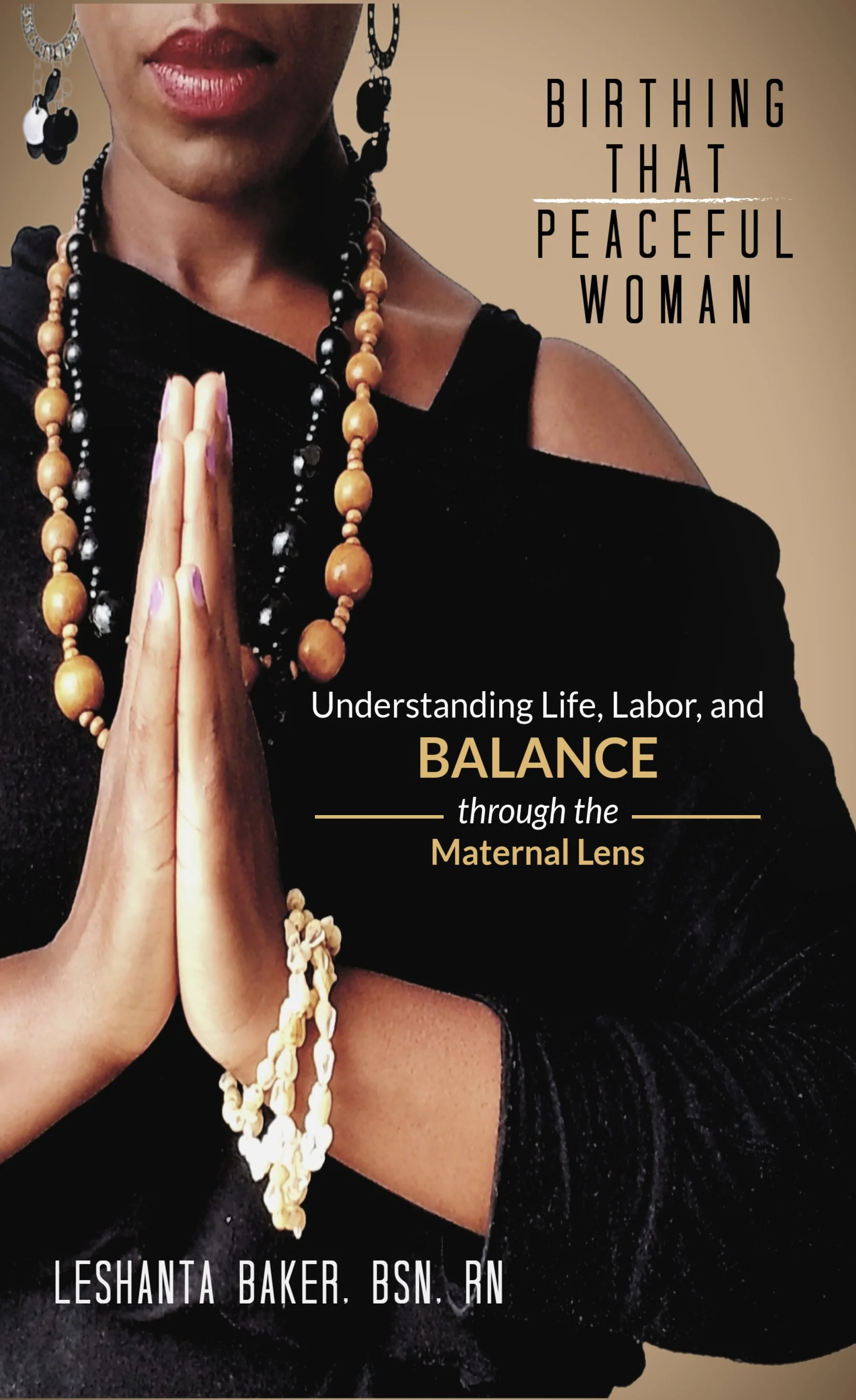
After years of writing, revising, questioning, editing, reorganizing, and overthinking, I have officially published my book!
Of all the poop I'm releasing today, this is by far the biggest dump. 😂 (I know, it’s probably not the wisest marketing strategy to associate my work with a word that also means defecation.)
While most are grossed out by it, us birth workers tend to get excited when it happens…in certain circumstances.
This book contains years of observations gathered through labor and delivery nursing, childbirth education, maternal-child health, movement instruction, coaching conversations, personal experiences, and my own journey through womanhood. While the maternal journey serves as the lens through which many of the lessons are explored, this is not simply a book about having a baby. It is a book about self-awareness.
One of the places where my philosophy differs from much of mainstream personal development is in the idea that we are constantly trying to become a new version of ourselves. The more I've observed pregnancy, birth, postpartum, parenting, womanhood, human development, and my own life, the less convinced I've become that growth is about becoming someone new. Instead, I've started wondering whether the core of who we are already exists and whether the challenge is not becoming a different person but learning how to repeatedly birth that person into changing environments, relationships, responsibilities, opportunities, and seasons of life.
When I look at pregnancy, I don't see a baby trying to become a baby. The baby already exists. What changes are the conditions surrounding that baby. The available space changes, the environment changes, the developmental stage changes, and the way the baby interacts with the world changes. I think much of human development works the same way. The woman I am today is not fundamentally different from the girl I was decades ago. The circumstances are different, my knowledge is different, my responsibilities are different, and the way I express myself in various environments is different, but there is a thread that has remained remarkably consistent throughout my life.
That realization has shaped the way I think about personal growth. Rather than trying to become someone else, I've become more interested in identifying the version of myself that feels peaceful, aligned, balanced, whole, and authentic, then learning how to express that person within whatever reality I'm currently navigating. The labor room has required something different than a boardroom. The clinic required something different than a client’s couch, as does the class compared to a feminine circle, or a stage versus a computer screen. Motherhood and marriage have for sure required something different than dating. And oh my help us all, perimenopause requires something different than menstrual cycles.
The environment changes, the demands change, and the situation changes, but the work remains the same: learning how to recognize yourself, trust yourself, and allow that authentic innate self to show up appropriately within each new moment and season of life.
That, more than anything, is what Birthing That Peaceful Woman is about. It's a book about self-awareness, observation, and learning a process that can be repeated throughout life whenever circumstances change. The goal isn't to create a new version of yourself. The goal is to understand yourself well enough that you can continue birthing the most peaceful expression of who you already are, regardless of where life places you next.
You can find Birthing That Peaceful Woman here:
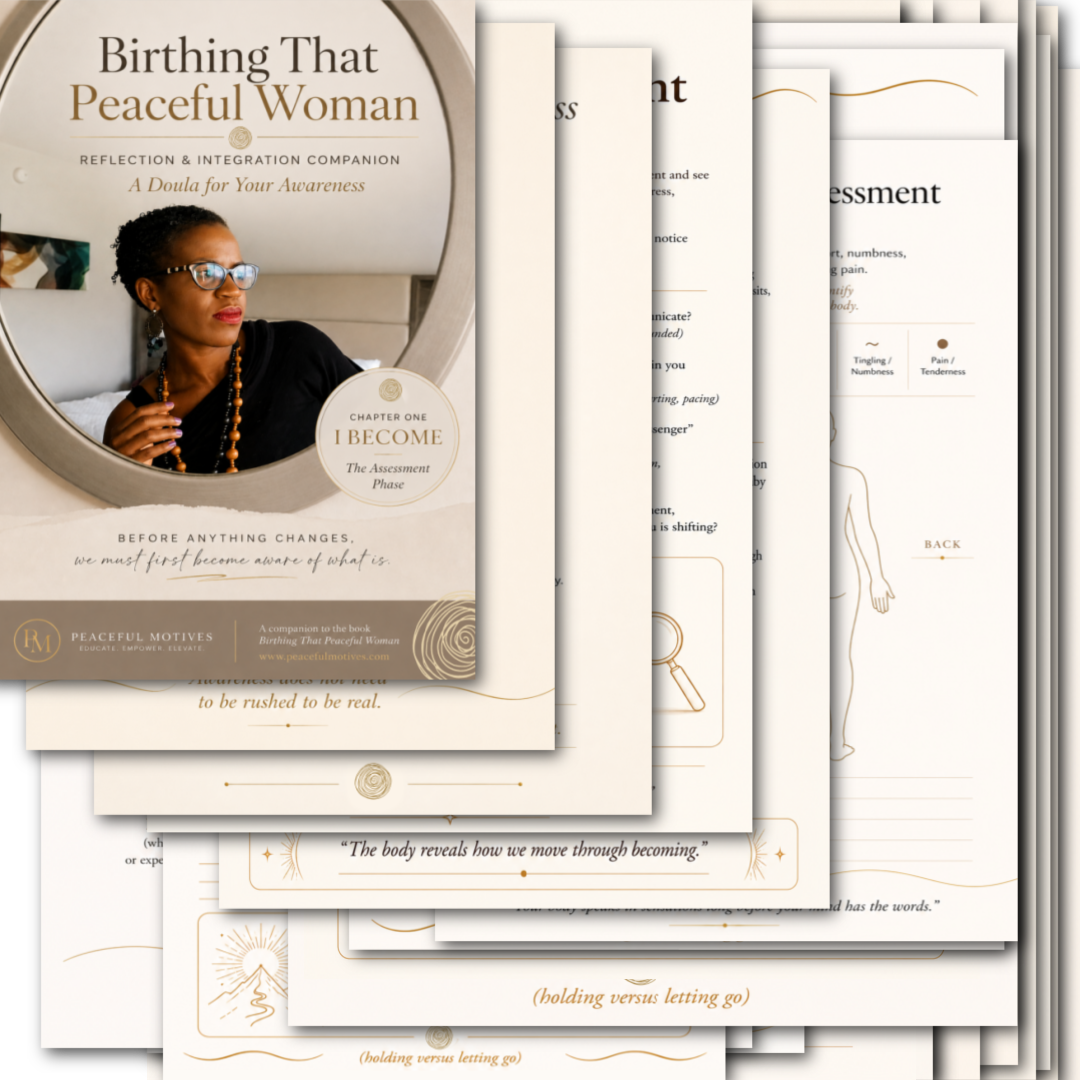
To help readers go deeper, I've also created a free companion reflection guide for Chapter One. It’s a lengthy one but don’t be overwhelmed. The guide is designed for you to take your time, chew thoroughly, and let everything process to help you move beyond the habitual practice of simply reading through material and consuming information. The goal is that you can fertilize your life with all you process through self-assessment, reflection, and personal exploration. The link is included inside the book, but you can also access it here:
As I reflected on this idea of releasing information, another realization surfaced.
Years ago, we had two dogs and a cat. We eventually had to buy a hooded litter box because the dogs kept trying to eat the cat's poop. I know, now I’m really getting gross.
To our family, this was absolutely disgusting. To the dogs, however, it appeared to be a delicacy. 🤮
Lately, as I scroll social media, I think about that litter box.
We are all consuming information that someone else finds ridiculous, offensive, dangerous, empowering, inspiring, foolish, enlightening, or absurd.
One person's garbage is another person's treasure. One person's truth is another person's nonsense. One person's fertilizer is another person's waste. That doesn't mean all information is equally valuable, but it does remind me that each of us is responsible for developing our own filtration system. We have to decide what we consume, what we hold onto, what we question, and what we release.
Memorial Day weekend, another layer was added to the analogy while talking with someone I care about deeply. (Smooches to her😘.). We were watching a webinar about speaking on a TED or TEDx stage. As we listened, I found myself smiling inside because I realized that TED Talks are essentially organized opportunities for people to release what they've been processing. Someone spends months, years, or sometimes decades wrestling with an idea, an observation, a lesson, a question, or an experience before stepping onto a stage and sharing it in hopes that it sparks conversation, shifts perspective, challenges assumptions, or helps someone else see the world differently.
That thought led me to think more about the fertilizer. (I know, this is really how my mind works.)
Just think about it.
Something one system no longer needs becomes nourishment for future growth somewhere else.
Maybe our stories work the same way. Maybe our experiences, lessons, observations, and insights are meant to become nourishment for someone else's growth. Not every idea is healthy and not every perspective is wise, which is why discernment matters, but there is still something beautiful about recognizing that what we release may become part of someone else's transformation.
The reason this analogy feels so personal to me is because I've never been particularly good at pooping. Those who may feel too privy to my oversharing can attest to that. After some testing this year, I learned that my body hasn't been producing enough acid to properly break things down. Things had been sitting longer than they should, fermenting, creating pressure, building up gas, and becoming increasingly uncomfortable. As I reflected on that, I couldn't help but notice how often the same thing happens mentally and emotionally. We take in information constantly but don't always make time to process it. We keep consuming without creating enough space to digest.
Over the years I've learned that different things can help. Of course the basics: hydration, fiber, movement, and sometimes a stool softener helps. Other times what I really need is something that stimulates movement altogether. As strange as it sounds, that realization has shaped the way I think about personal growth. Therapy, coaching, journaling, support groups, cohorts, circles, and even TED Talks create opportunities for people to process what they've been carrying around.
Recently a registered dietitian told me that people struggling with constipation sometimes benefit from simply scheduling time to sit on the toilet, whether they feel the urge to go or not. The consistency itself can help stimulate the body's natural process. That advice stayed with me because I think the same thing happens in many areas of life. We avoid journaling because we don't know what to write. We avoid therapy because we think we don't have anything to talk about. We avoid reflection because we're busy. Then we finally sit down, and suddenly all kinds of things start coming to the surface. It made me wonder whether those spaces don't simply hold release. Maybe they stimulate it.
As a birth worker, I can't help but take the analogy one step further. Years ago, it was common practice to give laboring mothers enemas. Part of the rationale was that emptying the bowels might create more room for baby to descend, stimulate labor, or reduce infection. Over time, evidence showed that routine enemas weren't necessary. Women poop during labor all the time, and birth workers generally don't give it a second thought. However, anyone who has spent enough time working closely with laboring bodies can appreciate how closely connected these systems are. There have been times when severe constipation appeared to be contributing to a lack of space, and there have also been times when the release of stool coincided with labor progressing more comfortably and baby continuing to descend. Whether coincidence, mechanics, or a combination of many factors, those experiences repeatedly reminded me that creating space matters.
The older I get, the more I wonder how many of us are trying to birth something into our lives while carrying things that no longer belong there. We hold old fears, old stories, old disappointments, old expectations, old identities, old information, and old wounds long after they've served their purpose. Some of those things still belong. Some don't. If we never process them, however, they continue occupying space that may be needed for whatever is trying to emerge next.
Perhaps that is why I've become so passionate about creating spaces where women can pause long enough to process what they've been carrying. I've come to believe that many of us aren't suffering from a lack of information. We're suffering from a lack of time and space to digest what we're already consuming. Sometimes what we need isn't more information. We simply need movement, reflection, conversation, community, and a place where it's safe to release what we've been carrying.
That belief has become the foundation of my work and the reason I created the offerings below.
This year I promised myself that I was going to release my voice. Not after every idea is perfectly formed, not after every sentence is polished, and not after I know exactly how others will respond. Just honestly.
So consider this my first official blog, this is my official book announcement, my announcement of what is still to come, and perhaps my biggest poop release yet.
And if anyone asks...
Yes.
She's got more poop!
Places to Continue Processing the Poop
Birthing That Peaceful Woman
The book that inspired this entire blog.
ORDER COPY
Free Reflection Companion
A guided self-assessment companion designed to help you apply the concepts from the first chapter.
DOWNLOAD